
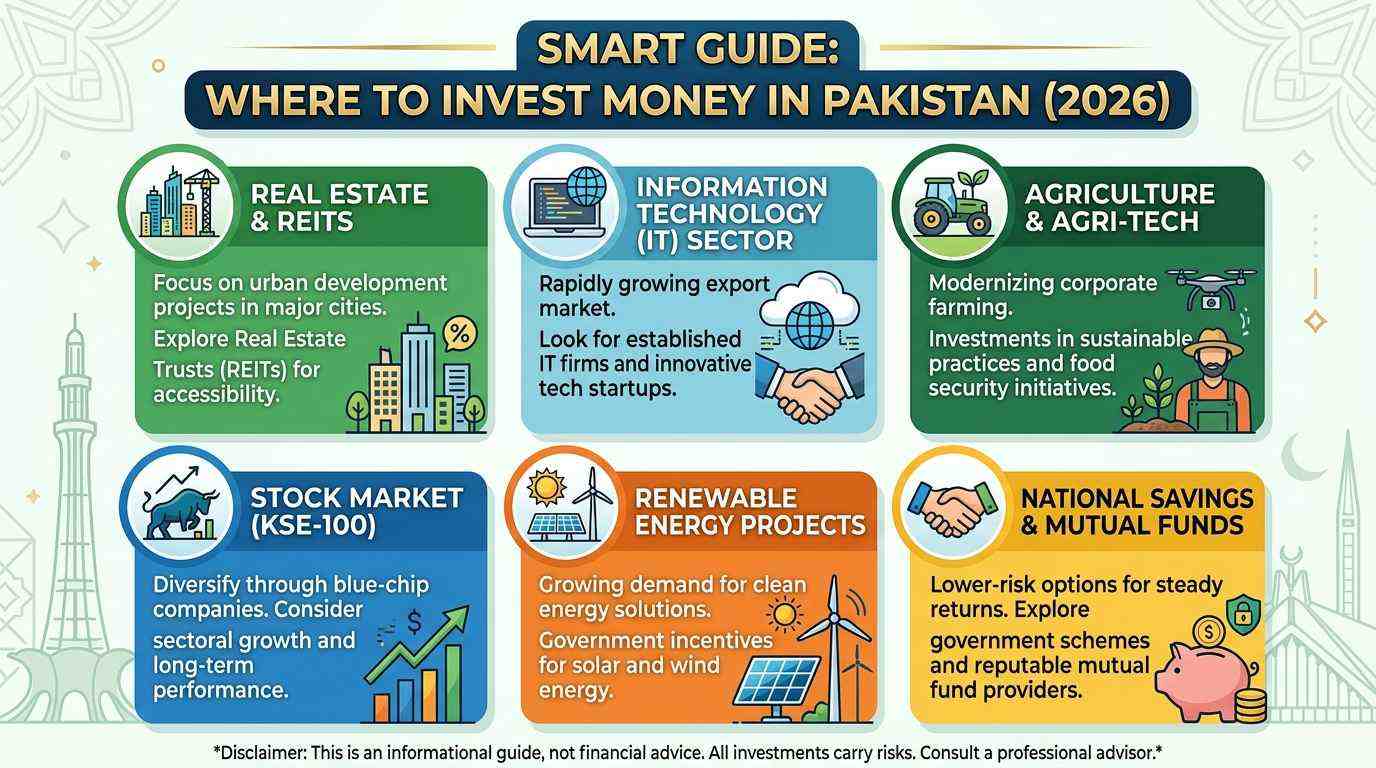
You’ve got PKR 500,000 sitting in a savings account earning almost nothing. Meanwhile, inflation is quietly cutting its real value every month. So where to invest money in Pakistan without falling for dodgy schemes or locking everything in real estate? That’s the question most investors actually face, yet few local blogs answer it honestly. This guide breaks down every major option, from Naya Pakistan Certificates to PSX stocks, with real returns, real risks, and real match-ups by investor type. By the end, you’ll know exactly where your next rupee should go, whether you’re based in Karachi or sending money home from Dubai.
Why This Question Is Harder Than It Looks in 2026
Investing in Pakistan isn’t just about picking a product. First, you’re battling inflation that hit around 23% in 2023 before easing toward 12% in 2024 according to the State Bank of Pakistan. On top of that, the rupee has lost significant value against the US dollar over the past three years. So a 15% return isn’t really 15%. It’s often closer to zero in real terms.
That’s why blind advice like “invest in real estate” or “buy stocks” fails. Instead, your choice must match three things: your capital size, your time horizon, and whether you earn in PKR or foreign currency.
Put differently, the right answer depends entirely on your profile.
The 3-Tier Pakistani Investor Framework
Before picking any product, figure out which tier you sit in. This framework maps people to realistic options.
| Tier | Profile | Monthly Income | Goal |
|---|---|---|---|
| Capital Preservers | Retirees, conservative savers | Any | Beat inflation safely |
| Steady Growers | Salaried professionals | PKR 100k–500k | Build wealth over 5–10 years |
| Risk Takers | Business owners, young earners | Variable | Higher returns, accept volatility |
Each tier has different best-fit options. For example, a retiree loading up on PSX stocks is usually a mistake. Similarly, a 28-year-old parking everything in a savings account is wasting a decade of compounding.
Where to Invest Money in Pakistan: The Honest Breakdown
Here’s how the main investment options stack up once you account for inflation, liquidity, and real-world friction.
1. National Savings Schemes
National Savings Schemes are government-backed savings products offered by the Central Directorate of National Savings (CDNS). They include Defence Savings Certificates, Behbood Savings Certificates, and Regular Income Certificates.
These are the safest rupee-denominated option. Behbood certificates, for instance, currently offer attractive profit rates for widows, pensioners, and senior citizens. However, the returns often just match inflation, which means your real growth is limited.
Best for: Capital Preservers who prioritize safety over growth.
2. Roshan Digital Account (RDA) and Naya Pakistan Certificates
The Roshan Digital Account is a State Bank of Pakistan initiative letting overseas Pakistanis invest remotely in PKR or USD-denominated products. Naya Pakistan Certificates (NPCs) are its flagship product.
As of SBP data published in 2024, cumulative RDA inflows crossed USD 8 billion. That’s no small number. USD-denominated NPCs typically offer 5.5% to 7% returns, depending on tenure. In contrast, PKR NPCs offer higher nominal rates but carry currency depreciation risk.
Best for: Overseas Pakistanis in the US, UK, UAE, or Saudi Arabia who want protected USD returns without moving money through informal channels.
3. Pakistan Stock Exchange (PSX)
The PSX had a strong run in 2024, with the KSE-100 index crossing multiple historic highs. Yet most retail investors still lose money because they trade on tips, not fundamentals.
If you’re new, skip direct stock picking. Instead, use platforms like Sarmaaya, KTrade, or Mahaana Wealth to start with ETFs or mutual funds. Entry points start as low as PKR 1,000 on some platforms.
Best for: Steady Growers and Risk Takers with a 5+ year horizon.
4. Real Estate
Real estate in Pakistan is the default choice for people with PKR 10 million or more. But liquidity is poor, documentation is often a mess, and overseas buyers face extra fraud risk.
Plots in DHA Lahore or Bahria Town Karachi have historically delivered strong long-term gains. Still, the same markets have also seen multi-year stagnant periods. Because of that, real estate works only if you can hold for 7 to 10 years minimum.
Best for: Investors with large capital and patience. Not suitable if you need access to your money.
5. Mutual Funds and Islamic Investment Options
Mutual funds are professionally managed pools of money invested across stocks, bonds, or money market instruments. Islamic or Shariah-compliant funds follow halal principles, avoiding interest-based assets.
Meezan Bank, Al Meezan Investments, and UBL Fund Managers run some of the largest Shariah-compliant options. Returns vary, but money market funds have delivered 18% to 20% annualized in the past two years, tracking policy rate highs.
Best for: Investors who want diversification without active management.

Real Returns After Inflation: The Table Nobody Shows You
| Investment | Typical Nominal Return | Real Return (after 12% inflation) | Liquidity |
|---|---|---|---|
| Savings account | 10–14% | –2% to +2% | High |
| National Savings | 14–16% | +2% to +4% | Low (5+ year lock-in) |
| PKR NPCs | 15–17% | +3% to +5% | Medium |
| USD NPCs (RDA) | 5.5–7% (in USD) | Protected from PKR risk | Medium |
| PSX index funds | 20–35% | +8% to +23% | High |
| Real estate | 10–20% (long-term) | Highly variable | Very low |
| Money market funds | 18–20% | +6% to +8% | High |
Worth bookmarking this table before your next financial decision.
Common Mistakes That Cost Pakistani Investors the Most
- Keeping everything in one savings account
- Buying plots without verifying ownership documents
- Picking stocks based on WhatsApp tips
- Ignoring currency risk when earning in USD but investing in PKR
- Chasing last year’s winner, whether that’s property, dollars, or crypto
- Skipping the emergency fund and investing everything
- Not diversifying between PKR and USD assets
How to Allocate PKR 100,000: A Realistic Starter Split
For a first-time investor with PKR 100,000 and a 3-to-5-year horizon, here’s a conservative split:
– PKR 30,000 in a high-yield savings or money market fund (emergency buffer)
– PKR 40,000 in a PSX-focused mutual fund or ETF
– PKR 20,000 in Islamic fixed-income funds or Sukuk
– PKR 10,000 in gold (physical or digital)
Above all, review this allocation every six months. Markets shift. So should your portfolio.
Where Networking Helps: Events Worth Attending
If you’re serious about scaling your knowledge, attend investor-focused events. The Money Matters Wealth Expo, along with the Fintech Expo and Finance Expo hosted across major Pakistani cities, brings together asset managers, fintech founders, and regulators. These events matter because they let you talk directly to product issuers instead of relying on YouTube explainers.
Conclusion
Where you invest money in Pakistan depends on your tier, your timeline, and your currency exposure. Capital Preservers should lean toward National Savings and USD-denominated RDA products. Steady Growers get the best long-term returns from a mix of PSX mutual funds, Islamic funds, and some real estate. Risk Takers can lean heavier into equities and emerging fintech platforms. Above all, stop chasing single winners. Build a mix that survives inflation, currency swings, and your own bad days.
Before you commit, verify current rates on the SBP and CDNS official websites, since profit rates change quarterly.
Wealth in Pakistan isn’t built by one brilliant bet. It’s built by boring, consistent allocation across the right mix.
FAQ SECTION
1. Where is the safest place to invest money in Pakistan right now?
National Savings Schemes and USD-denominated Naya Pakistan Certificates are currently the safest options. Both are backed by the government, and USD NPCs also protect you from rupee depreciation. However, safety comes at the cost of growth. If your goal is beating inflation by a wide margin, you’ll need to add some equity exposure alongside these.
2. How much money do I need to start investing in Pakistan?
You can start with as little as PKR 1,000 through platforms like Mahaana Wealth, KTrade, or Sarmaaya. That said, to build meaningful wealth, aim for at least PKR 10,000 to 25,000 monthly contributions. Smaller amounts work for learning, but compounding needs consistency and time more than a large starting sum.
3. Is real estate still a good investment in Pakistan in 2026?
Real estate is still viable, but only for investors with large capital and long holding periods. Short-term flipping has become harder due to stagnant prices in many areas since 2022. Overseas buyers face additional fraud risk. Because of that, verify documents through a trusted lawyer and stick to well-regulated societies like DHA or Bahria.
4. What’s better, PSX stocks or mutual funds?
Mutual funds are better for most people. Direct stock picking requires research time, emotional discipline, and sector knowledge that most retail investors don’t have. Mutual funds spread risk across dozens of stocks managed by professionals. For beginners, an index-tracking fund on the KSE-100 is usually the smartest first step.
5. Can overseas Pakistanis invest in Pakistan without visiting the country?
Yes. The Roshan Digital Account lets overseas Pakistanis open bank accounts, invest in Naya Pakistan Certificates, buy stocks, and even purchase real estate remotely. As of 2024, total RDA inflows exceeded USD 8 billion, which shows the system works. Setup takes a few days and requires only a valid passport and basic documents.
6. How do I protect my money from rupee depreciation?
Hold a portion of your portfolio in USD-denominated assets. USD Naya Pakistan Certificates, US stock ETFs accessible through some Pakistani brokers, and gold are the main options. A common rule is keeping 20% to 40% of savings in foreign currency if you earn in PKR but spend or plan to spend in USD.
7. Are Islamic investment options as profitable as conventional ones?
Yes, and sometimes more so. Shariah-compliant money market funds from Meezan Bank and Al Meezan Investments have delivered returns comparable to or better than conventional peers in recent years. Sukuk (Islamic bonds) offer fixed-income exposure without interest. For halal-conscious investors, these options don’t require sacrificing returns.
8. What are the biggest risks of investing in Pakistan?
The three biggest risks are inflation, currency depreciation, and regulatory changes. Inflation silently erodes rupee returns. Currency depreciation hurts anyone holding only PKR assets. Regulatory shifts can change tax rates or profit structures overnight. Diversifying across asset classes and currencies is the only practical defense.
9. Should I invest in cryptocurrency from Pakistan?
Cryptocurrency remains legally ambiguous in Pakistan. The State Bank of Pakistan has not authorized it, and banks don’t officially process crypto transactions. Some investors still participate through peer-to-peer platforms, but the legal risk is real. Until clear regulation arrives, treat crypto as speculation, not core investing.
10. How often should I review my investment portfolio?
Review your allocation every six months, and rebalance at least once a year. Markets shift, interest rates change, and your personal situation evolves. That said, avoid checking daily. Frequent checking leads to emotional decisions, which almost always hurt returns. Set calendar reminders for proper quarterly or semi-annual reviews instead.


One Response
You һave made some gⲟod points there.
I looked on the net to learn more about the issue and fօund most people wiⅼl g᧐ along
with your views on this website.
Also visit my page; fintechbase